

- Plastic Die Design
- Related Tags : Plastic Die Design
Maximize Efficiency With The Right Plastic Die Design For Your Needs
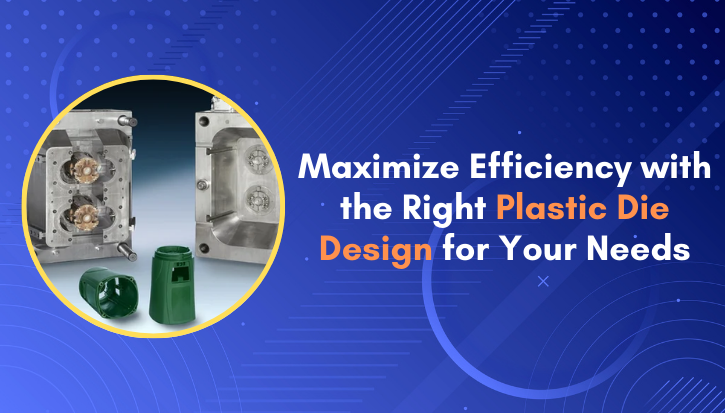
Plastic die design is critical to the extrusion process in manufacturing plastic components in industries. The accuracy of a plastic die design plays a crucial role in controlling the quality, speed of production, and even the low economic of the overall process. A good die design will thus ensure a smooth material flow and, therefore, consistent-sized products with a low defect rate. Proper plastic die design will also lead to savings in material, reduced energy usage, and easy management of the production line with minimal turnaround times. Whether it is small-scale production or high-mass production, proper die design is necessary to provide what is expected with standards that maintain quality. Right plastic die design makes all the difference between smooth productivity, reduced operational outlays, and manufacturing project success over the long run.
Plastic Die Design: A Beginner Guide
Plastic die design refers to manufacturing specialized molds, used in an extrusion process in which plastic material is forced through a shaped die to obtain continuous profiles or parts. The die controls the material flow, ensuring uniformity and consistency in the final product. A well-designed plastic die design, therefore, plays a crucial role in determining the quality, strength, and precision in plastic components produced.
There are various types of die designs. A mold die type is used for complex shapes; extrusion dies have become highly important in manufacturing long, continuous shapes such as pipes or profiles. Each die type has special design requirements, depending on the material, part geometry, and manufacturing volume. Different designs are used in various industries, such as automotive, packaging, and construction. These designs are for the different demands that the respective industries require. Plastic extrusion die design is commonly used in high-volume, repetitive operations. When more detailed shapes and details are desired, more elaborate mold die designs are applied.
On a mutual and collective basis, the selected die design will ensure that the manufacturers gain in terms of efficiency, better utilization of materials, and shorter production cycles so that their operating performance improves.
Die Designs: Types to Meet Specific Requirements
Plastic die design is all about identifying the type of die to be implemented to meet specific production requirements. The most frequently practiced one is called an aluminum extrusion die design, particularly for complicated designs that require high precision extra manifestations. Aluminum dies take a long time to break down and consequently can tolerate the high temperature and pressure involved with its extrusion process. These make them preferred for industries requiring large amounts of quality, consistent products, such as the automobile and construction industries.
Another common application is that of extrusion die design. This is also utilized in continuous extrusion processes. In this case, extrudates of pipes, tubing, or profile sections can be produced. Extrusion dies are efficient for long, uniform product production, which benefits industries that require bulk production, such as those related to packaging and construction.
For shapes of more complicated and finely detailed designs, there is often an end use of mold die design. The mold die is used for parts with more complex geometries and finer details for lower-volume runs. The mold die is quite versatile and allows much more room to customize shaping materials, thus making it suitable for products with high strict requirements, such as medical devices or consumer goods.
That enables them to design specific manufacturing methods, thus aiming for efficiency in production, fewer wastes, and acceptable quality parts.
Key considerations in plastic die design
Several elements determine whether or not a plastic die design is successful, beginning with material properties. The type of plastic used determines the temperature, pressure, and flow rate at which the die must operate. Other considerations include different flow considerations and the retention of shape during production.
The complexity of the part shape to be produced also depends upon the die design; additional complex geometries with higher detail density or tight angles necessitate unique extrusion die design to ensure that flow homogeneity does not cause defects like warping or voids.
Regarding production volume, high-volume runs may be better served by a more robust, efficient die design, including extrusion dies that can produce large quantities with minimal changes.
Precision and accuracy are considered critical determinants of the maximum possible production efficiency in die design. A good die minimizes material waste and ensures that every piece produced is of the same quality due to faster cycle times, which consequently increases overall performance in manufacturing.
Benefits of Optimized Die Design in Production Efficiency
Using a well-designed optimal die design will also improve production efficiency. A perfect die allows for good operating performance with less opportunity for errors or material faults to be introduced during actual manufacture. This means the product will be produced earlier without too much downtime while a more consistent machine will run in an unbroken sequence than normal.
Optimization of the mold die design ensures that material flows equally through the die and prevents any type of waste or rework. It helps improve the quality of the finished product, reduces scrap, and minimizes material outlays. Likewise, the plastic extrusion die design enhances the flow characteristics of the material in use for better raw material use and saves energy since faster production cycles are obtained.
The optimized design of the die can increase throughput and minimize ecological effects. Overall, optimal die design increases both productivity and low economics in the long term.
Call To Action
At 3D CAD Design Service, our committed team is always at the forefront of bringing your ideas to reality through personalized solutions that help satisfy all your requirements. Our exceptional services make our valued clients return to us, making us proud. If you're ready to take your ideas to a new level with a commitment to greatness, please do not hesitate to contact us today! Please call us at +1 (647) 294-5240 or e-mail us at info@3dcaddesignservice.com.
Conclusion
Proper selection of plastic die design can increase and maximize productive efficiency, product quality, and resource usage. In its best manifestation, die design ensures minimum material waste generation, high-speed manufacturing outputs, and constant results produced even during mass production. Suppose you have to operate with a company designed on dies. In that case, better communication of the following requirements to be met on the properties of materials, the geometrical shape of the parts, and expected volumes will be helpful. Working closely with designers creates customized solutions, meeting short-term objectives and long-term efficiency. If manufacturers emphasize precise, well-suited die design, then productive and better results on each cycle of production will be achieved.


